03. Random Networks
Contents
- 03.01. Introduction
- 03.02. The Random Network Model
- 03.03. Number of Links
- 03.04. Degree Distribution
- 03.05. Real Networks are Not Poisson
- 03.06. The Evolution of a Random Network
- 03.07. Real Networks are Supercritical
- 03.08. Small Worlds
- 03.09. Clustering Coefficient
- 03.10. Summary: Real Networks are Not Random
- ...
- 03.16. Advanced Topic 3.E Fully Connected Regime
03.01. Introduction
03.02. The Random Network Model
nodes, connected w/ probability
Box 03.01. Defining Random Networks
-
model :
- labeled node are connedted with randomly placed links
- fixes the total num of links
- average degree of node
-
model :
- labeled nodes is connected with probability
- fixes prob

random graph (random network, Erdős-Rényi network)
Box 03.02. Random Networks: a Brief History
- Anatol Rapoport
- Random graph theory Pál Erdős and Alfréd Rényi
- Edgar Nelson Gilbert
03.03. Number of Links
- prob that of attempts to connect pairs of nodes have result in link, is
- prob that the remaining pairs of nodes have not resulted in a link is
- conmbinational factor
expected num of links
from to

, ,
,
Box 03.03. Binomial Distribution: Mean and Variance
standard deviation
03.04. Degree Distribution
degree dist , degree
| Binominal | Poisson | ||
|---|---|---|---|
| degree dist | |||
| peak at | |||
| width |

03.04.01. Binomial Distribution
prob that node has links is product of 3 terms:
- prob that of its links are present /
- prob that remaining () links are missing /
-
average degree second moment & variance
03.04.02. Poisson Distribution
sparse networks:
eq.3.7 is approx'd by Poisson dist
degree distributioin of a random network
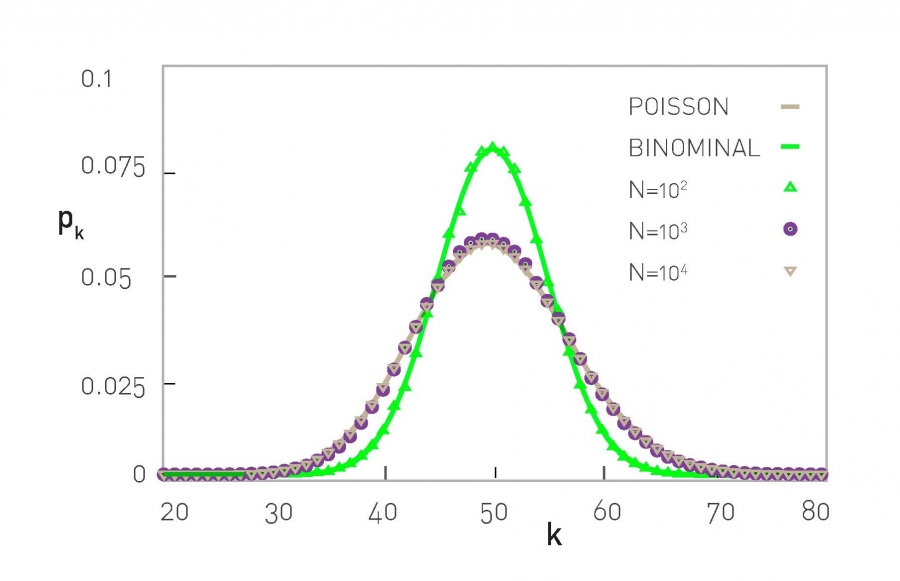
The degree distribution of a random network with ‹k› = 50 and N = 102, 103, 104. Small Networks: Binomial For a small network (N = 102) the degree distribution deviates significantly from the Poisson form (3.8), as the condition for the Poisson approximation, N»‹k›, is not satisfied. Hence for small networks one needs to use the exact binomial form (3.7) (green line).
Large Networks: Poisson For larger networks (N = 103, 104) the degree distribution becomes indistinguishable from the Poisson prediction (3.8), shown as a continuous grey line. Therefore for large N the degree distribution is independent of the network size. In the figure we averaged over 1,000 independently generated random networks to decrease the noise.
03.05. Real Networks are Not Poisson
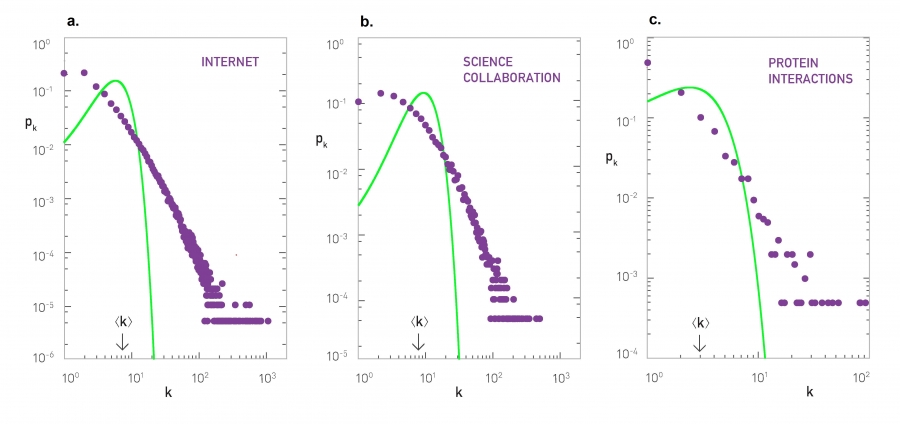
social network , of individuals
accuaitances
despersion of random network is , for range
in a large random network the degree of most nodes is in the narrow vicinity of
Box 03.04. Why are Hubs Missing?
the Stirling approx
rewrite eq.3.8 as:

03.06. The Evolution of a Random Network
the size of the largest conneted cluster w/i the network, varies w/
- for we have , ∴ and for large
- for we have , complete graph, ∴ and

grow from to if increase from to
Erdős P., Rényi A., 1960 condition for teh emergence of the giant component is (Erdős P., Rényi A., 1960):
express eq.3.10 in terms of using eq.3.3
the larger network, the smaller is sufficient for the giant component
4 regimes:
Subcritical regime: ()
for ,
∴ ,
Critical point: ()
size of the largest component is
in the limit
e.g., nodes
for ,
for ,
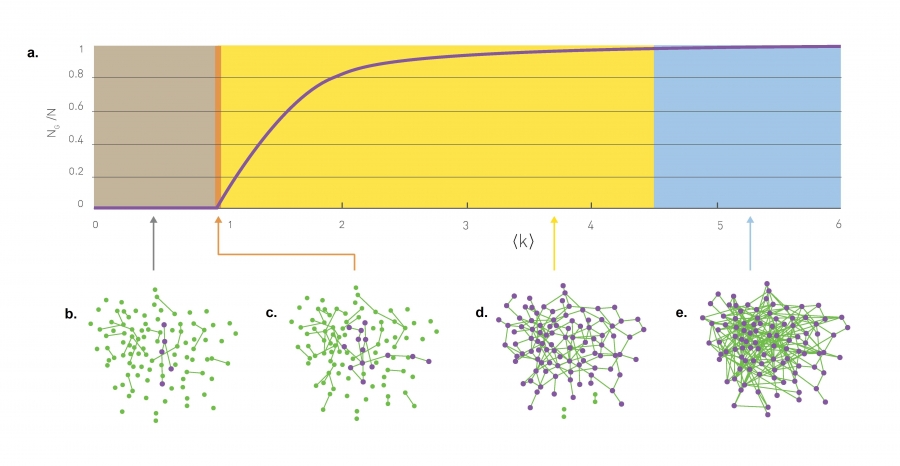
Supercritical Regime: ()
or
where is given by eq.3.11 ()
Connected Regime: ()
for large
Box 03.05. Network Evolution in Graph Theory
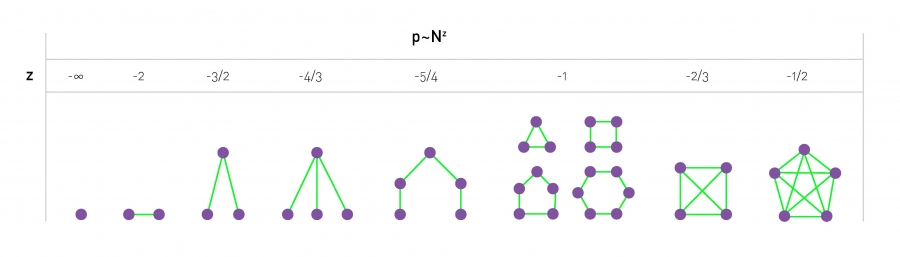
scales as where is tunable param
03.07. Real Networks are Supercritical
| Network | ||||
|---|---|---|---|---|
| Internet | 192,244 | 609,066 | 6.34 | 12.17 |
| Power Grid | 4,941 | 6,594 | 2.67 | 8.51 |
| Science Collaboration | 23,133 | 94,437 | 8.08 | 10.05 |
| Actor Network | 702,388 | 29,397,908 | 83.71 | 13.46 |
| Protein Interactions | 2,018 | 2,930 | 2.90 | 7.61 |
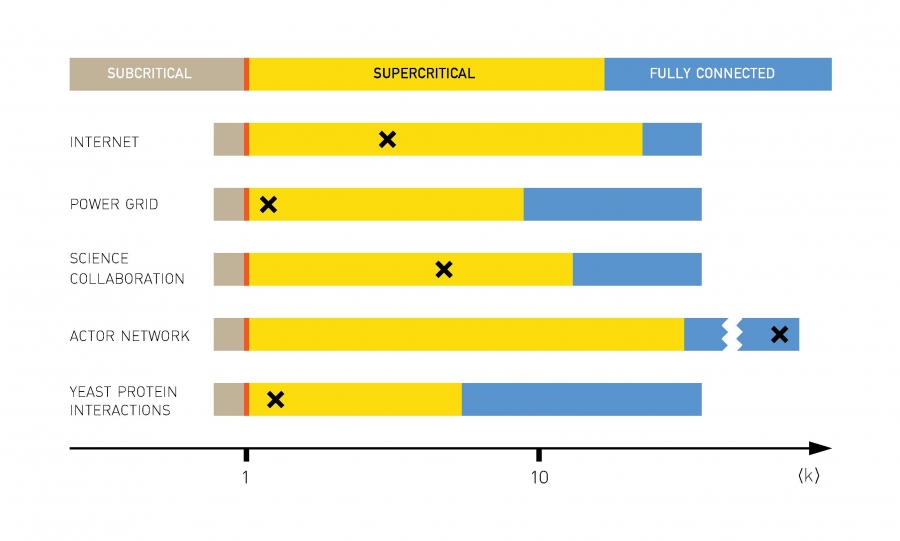
most real networks are in the supercritical regime
giant component coexist w/ many disconnected components
03.08. Small Worlds
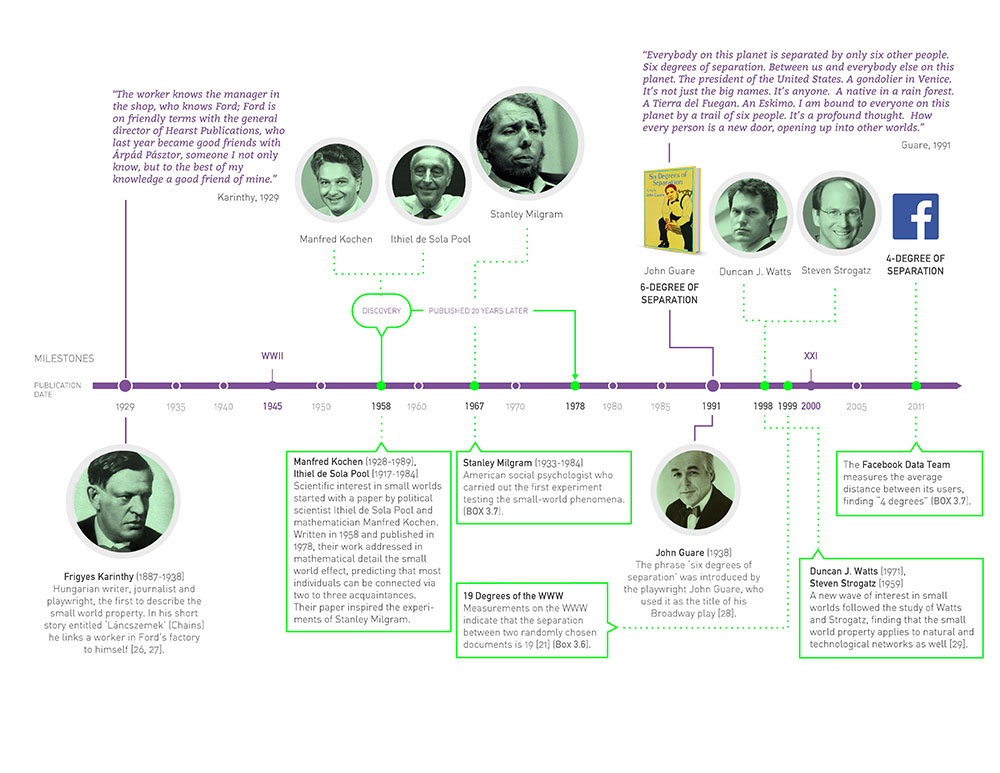
small world phenomenon aka, six degrees of separation
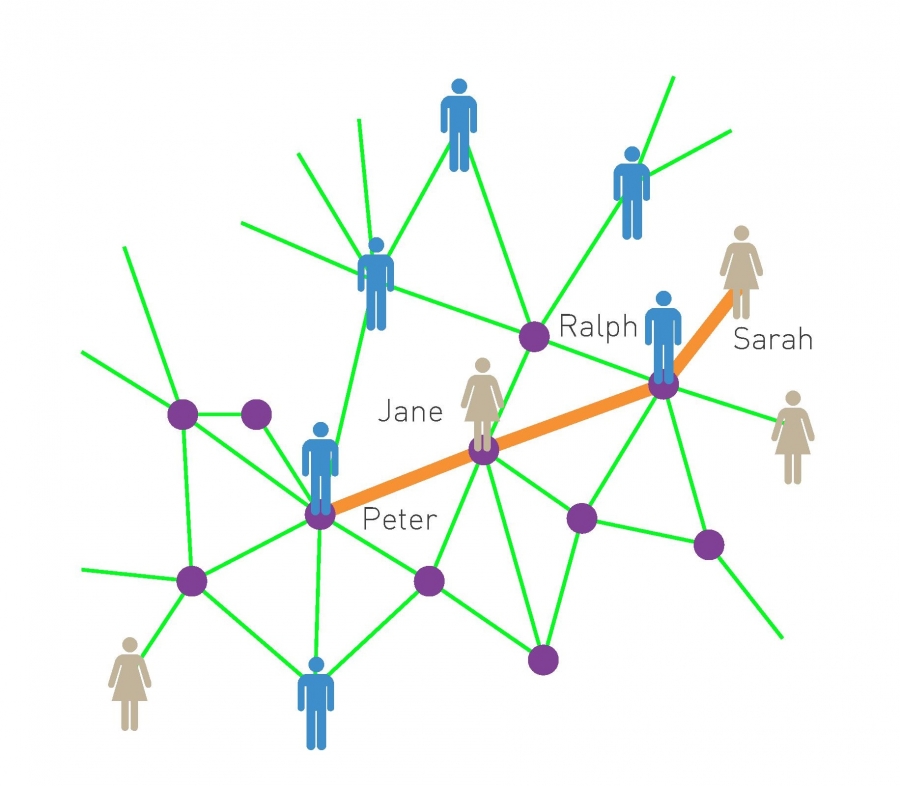
the distance between two randomly chosen nodes in a network is short
2 questions: - short mean - existenxe of these shord distances
- nodes at distance
- nodes at distance
- nodes at distance
- ...
- nodes at distance
num of nodes up to distance
max distance or the network's diameter
assuming the ,
∴ the diamter of network follows
-
average distance between 2 randomly chosen nodes
the small world property is defined by
-
, average path length or the diameter depends logarithmically on the system size
-
imply the denser the network, the smaller the distance
-
in real networks, systematic corrections to eq.3.19
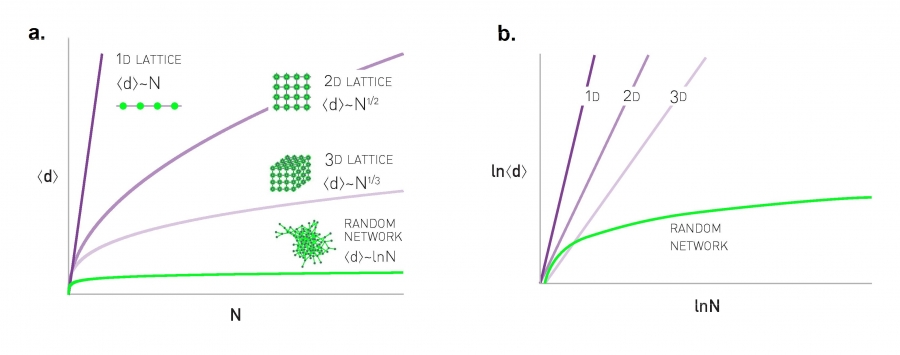
- 1D:
- 2D:
- 3D:
- 4D:
,
(de Sola Pool, I., Kochen, M., 1978 [20])
Box 03.06. 19 Degrees of Separation
finite size scaling (Albert, R., 1999)
(Lawrence, S., Giles, C.L., 1999)
19 degrees of separation

| Network | ||||||
|---|---|---|---|---|---|---|
| Internet | 192,244 | 609,066 | 6.34 | 6.98 | 26 | 6.58 |
| WWW | 325,729 | 1,497,134 | 4.60 | 11.27 | 93 | 8.31 |
| Power Grid | 4,941 | 6,594 | 2.67 | 18.99 | 46 | 8.66 |
| Mobile-Phone Calls | 36,595 | 91,826 | 2.51 | 11.72 | 39 | 11.42 |
| 57,194 | 103,731 | 1.81 | 5.88 | 18 | 18.4 | |
| Science Collaboration | 23,133 | 93,437 | 8.08 | 5.35 | 15 | 4.81 |
| Actor Network | 702,388 | 29,397,908 | 83.71 | 3.91 | 14 | 3.04 |
| Citation Network | 449,673 | 4,707,958 | 10.43 | 11.21 | 42 | 5.55 |
| E. Coli Metabolism | 1,039 | 5,802 | 5.58 | 2.98 | 8 | 4.04 |
| Protein Interactions | 2,018 | 2,930 | 2.90 | 5.61 | 14 | 7.14 |
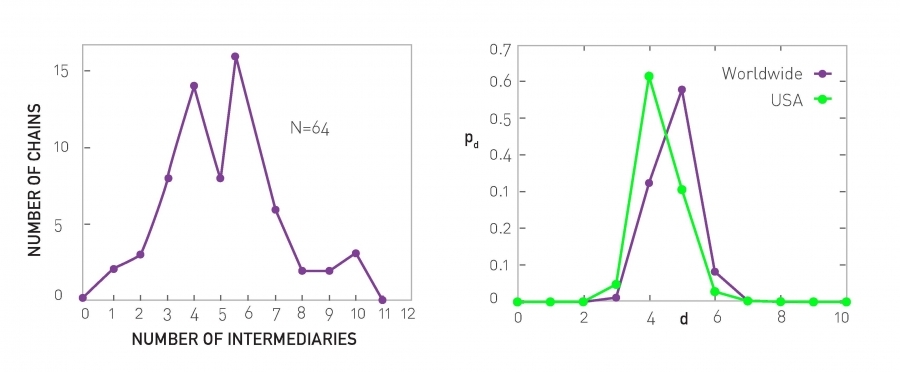
Box 03.07. Six Degrees: Experimental Confirmation
Box 03.08. 19 Degrees of the WWW
03.09. Clustering Coefficient
clustering coefficient , the density of the links in node 's immediate neighborhood
expected number of links
local clustering coefficient:
plot in fn of
NOT decrease as

Box 03.09. Watts-Strogatz Model
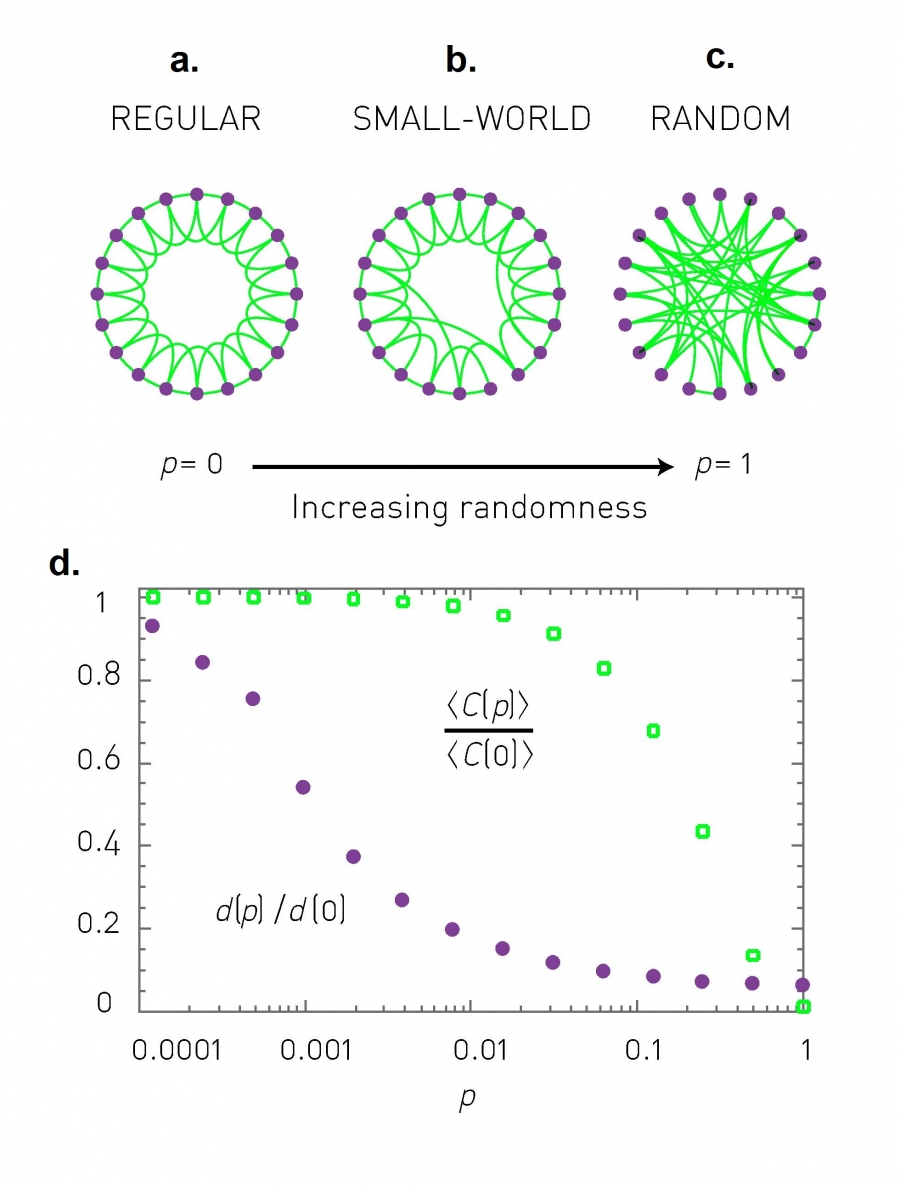
- Small World Property average distance depends logarithmically on
- High Clustering average clustering coef of real netw is higher than expected for a rand netw of similar and
Watts-Strogatz model (small-world model) interpolate
- Regular lattice:
- High clustering
- Small-world property(-)
- Random netw:
- Low clustering
- Small-world property(+)
03.10. Summary: Real Networks are Not Random
03.16. Advanced Topic 3.E Fully Connected Regime
in the
the num of isolated nodes is
for large ,
only one node is disconnected
, eq.3.40,
leads to eq.3.14